
By Simran Sethi, Senior Industry Solutions Consultant, Global Trade Intelligence, Descartes
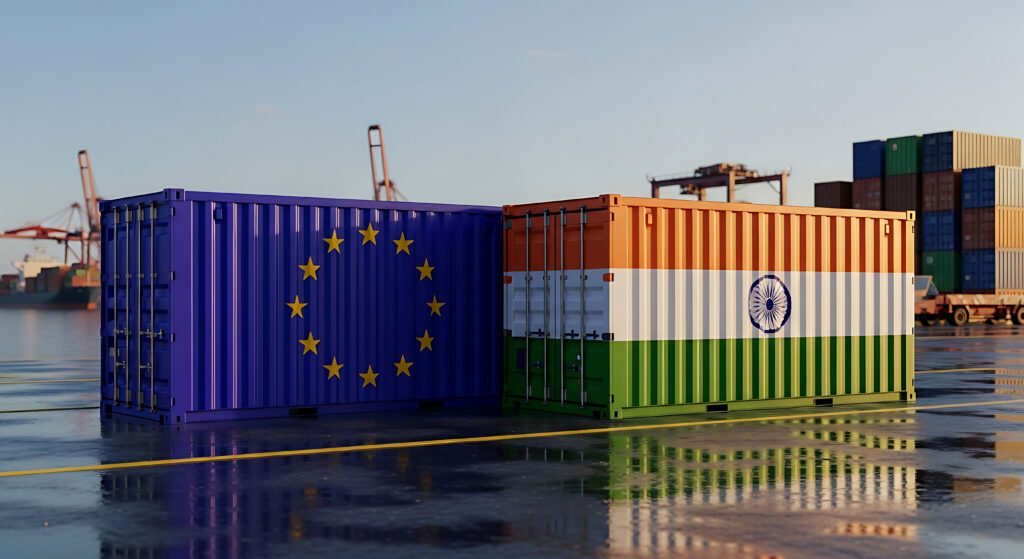
A Transformational Shift in EU–India Trade Relations
In January 2026, the European Union and India concluded negotiations on what is now the largest free trade agreement (FTA) ever agreed by either party. Covering markets that represent nearly a quarter of global GDP and close to two billion people, the agreement signals more than tariff liberalization — it represents strategic economic alignment between two major democratic trading blocs during a period of geopolitical realignment.
For trade compliance leaders, COOs, and CFOs, the EU–India FTA is not simply a trade policy milestone. It is a structural shift that will affect tariff exposure, sourcing models, digital trade governance, customs enforcement, and long-term supply chain resilience, all with substantial bottom-line benefits for companies taking advantage of the new framework.
To understand its impact, it is important to examine the relationship before the agreement, what has changed, and what this means operationally.
Key Takeaways for Trade Compliance and Executive Leadership
- The EU–India FTA represents a structural shift in bilateral trade, not just tariff cuts.
- Tariff reductions will create competitive advantages — but only if origin rules are properly managed.
- Customs cooperation mechanisms may increase origin verification scrutiny in early implementation phases.
- Digital trade recognition supports automation and modernization of compliance systems.
- Services liberalization expands opportunity but introduces regulatory navigation requirements.
- Supply chain diversification strategies may accelerate toward India as preferential access improves.
The Relationship Before the Agreement
Prior to the FTA, EU–India trade was robust but constrained. The EU has consistently been one of India’s largest trading partners, while India represents one of the fastest-growing major markets for European exporters. However, trade flows faced significant friction:
- High Indian tariffs in sectors such as automobiles, wines and spirits, processed foods, and machinery.
- Regulatory complexity and divergent technical standards.
- Customs bottlenecks and administrative unpredictability.
- Limited services market access.
- Absence of a modern digital trade framework.
Negotiations for a comprehensive FTA began in 2007 but stalled for over a decade due to disagreements over market access, investment protection, and regulatory standards. Talks were relaunched in 2022 amid global supply chain disruptions and strategic diversification efforts, culminating in political conclusion in January 2026.
The agreement represents a reset from a transactional trade relationship to a structured, rules-based economic partnership.
What the EU–India FTA Covers
The agreement is comprehensive and modern in scope. It includes commitments across:
- Tariff elimination and reduction on the vast majority of goods trade.
- Rules of origin and origin verification procedures.
- Customs cooperation and trade facilitation measures.
- Sanitary and phytosanitary (SPS) measures.
- Technical barriers to trade (TBT).
- Services liberalization across key sectors.
- Digital trade provisions recognizing electronic transactions and paperless trade.
- Intellectual property protections.
- Trade and sustainable development commitments.
- Structured dispute settlement mechanisms and mediation procedures.
- Institutional governance frameworks to oversee implementation.
For executives, the breadth of coverage matters: this is not a narrow tariff agreement, but a structural regulatory convergence framework.
Tariff Liberalization: Competitive Rebalancing
One of the most commercially significant outcomes is the elimination or phased reduction of tariffs on most bilateral trade by value.
For EU exporters, this means improved access to India in sectors previously constrained by high duties — including automotive components, industrial machinery, pharmaceuticals, chemicals, and certain agricultural products.
For Indian exporters, enhanced access to the EU market supports growth in textiles, engineering goods, leather products, and processed food sectors.
The tariff reductions are expected to materially alter pricing competitiveness and sourcing decisions across industries. However, realizing these benefits will depend entirely on compliance with rules of origin and documentation requirements — an area where many companies historically underperform.
Rules of Origin: The Compliance Pressure Point
One of the most frequently asked questions among trade compliance professionals is:
“How complex will origin qualification be, and what will customs authorities scrutinize?”
Like other modern FTAs, the EU–India agreement contains detailed origin rules defining when a product qualifies for preferential tariff treatment. These rules will likely include:
- Product-specific transformation requirements.
- Value content thresholds.
- Documentary and certification obligations.
- Verification cooperation between customs authorities.
Companies relying on multi-country supply chains must re-evaluate bill-of-materials structures to determine whether products genuinely qualify for preference.
The risk is clear: incorrect origin claims can result in back-duties demanded by customs, penalties, and reputational exposure.
Customs and Trade Facilitation: Predictability, but Not Deregulation
The agreement strengthens customs cooperation and introduces greater procedural transparency, including structured review and mediation channels.
However, executives should not mistake facilitation for deregulation.
Enhanced cooperation between EU and Indian customs authorities may increase data sharing and audit capability. Trade facilitation measures are typically accompanied by improved enforcement tools.
Another frequently raised compliance question:
“Will customs enforcement increase after the agreement enters into force?”
Historically, post-FTA environments often see a temporary increase in origin verification activity as authorities seek to ensure the integrity of the preference regime. Companies should anticipate audit scrutiny in the early implementation phase.
Digital Trade: A Structural Modernization
The inclusion of digital trade provisions is strategically significant. The agreement recognizes electronic authentication, paperless trade documentation, and digital contracting frameworks.
For multinational enterprises operating integrated trade management systems, this creates an opportunity to align documentation, automate origin tracking, and reduce manual compliance risk.
However, digital recognition does not eliminate data governance obligations. Companies must ensure compliance with both EU and Indian data protection frameworks when transmitting trade documentation electronically.
Services and Strategic Investment Implications
The agreement expands services market access across sectors such as financial services, telecommunications, maritime services, and professional services.
For multinational enterprises, this means greater operational flexibility — but also regulatory complexity. Market entry conditions, licensing requirements, and sector-specific restrictions will remain critical compliance considerations.
Notably, certain investment protection mechanisms remain subject to parallel negotiations, meaning the broader investment framework is not yet fully harmonized.
Strategic Implications for Supply Chain Leaders
The EU–India FTA arrives at a time when companies are actively pursuing supply chain diversification strategies.
Key executive considerations include:
- Can sourcing shift toward India to optimize EU tariff exposure?
- Will the agreement improve dual-sourcing resilience strategies?
- How will preferential access affect competitive dynamics against non-FTA countries?
- Does the organization have visibility into origin qualification across suppliers?
The agreement creates opportunity but only for organizations with granular supply chain intelligence.
Ratification and Implementation Timeline
Although politically concluded, the agreement must undergo legal review, translation, and ratification procedures within both the EU and India before entry into force.
Companies should begin scenario planning now rather than waiting for formal implementation. Early preparation reduces compliance disruption and accelerates benefit realization.
Final Thought
The EU–India Free Trade Agreement is a geopolitical and commercial milestone. It strengthens economic ties between two major markets at a time when global trade architecture is fragmenting.
For CFOs, COOs, and trade compliance leaders, the central question is not whether the agreement is significant — it is whether your organization is operationally prepared to capitalize on it.
Strategic advantage will belong to companies that treat this agreement not as a policy announcement, but as a compliance transformation moment.